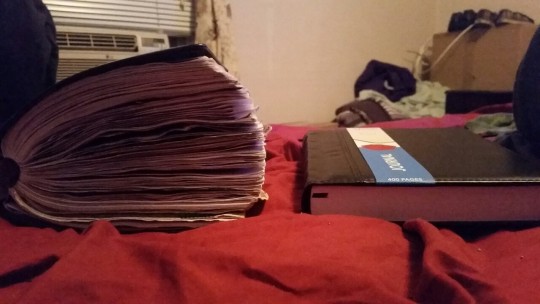
Please note that if you are using a hard bound notebook or journal, adding in additional pages will bulk up your book, like so: (these are the exact same journals, btw)
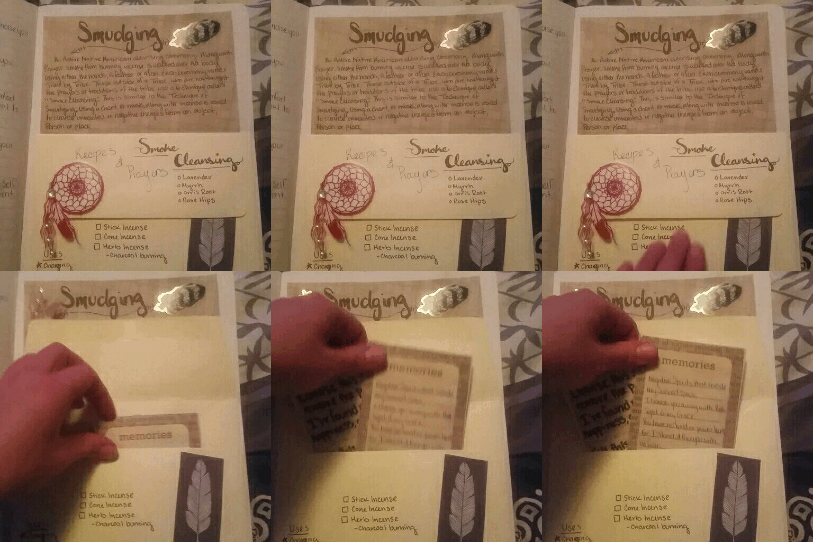
– Envelopes. Let’s say you’re doing a section on Tarot in your Grimoire, and you want to include a few Tarot spreads, but you don’t want to waste two or three pages. Glue an envelope onto one of your pages to make a “pocket” where you can store little cards or papers with the tarot spreads written on them.
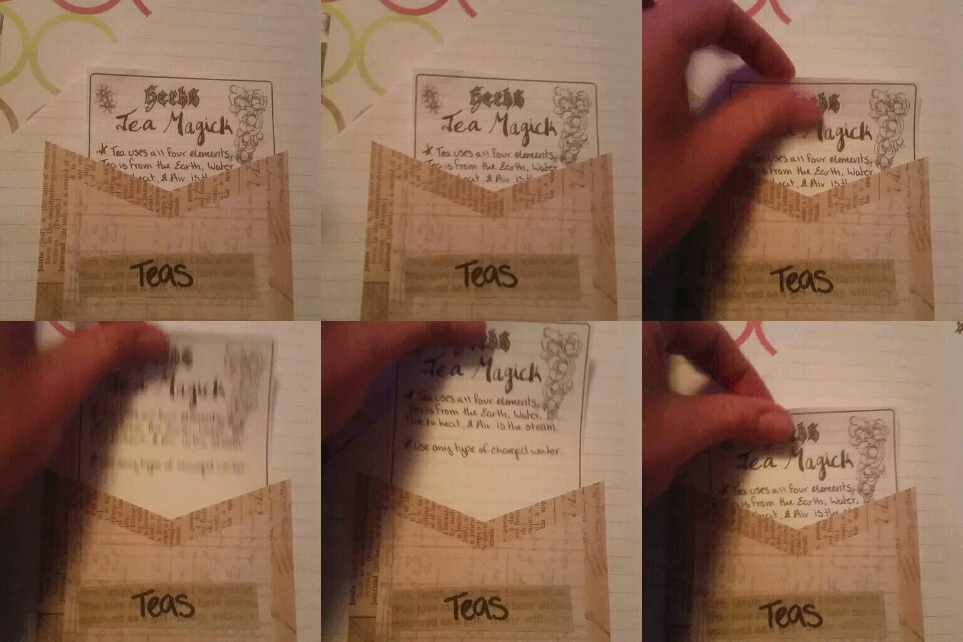
– Pockets. Similar to the envelope idea. If you have a page, or section for example, on herbal teas, you can make a pocket out of a piece of paper to keep your current favorite tea recipes in.
– Dividers, Cover Pages and Ribbons. If you’re like me and you like to have “sections” in your grimoire, you can easily make dividers by gluing a sheet of paper in your book (to make it heavier to make the sections stand out more). You can go further by turning your divider into a cover page for that section. And if you don’t like the idea doing that, you can always glue a ribbon, or a string, to the spine of your book to act as a bookmark.
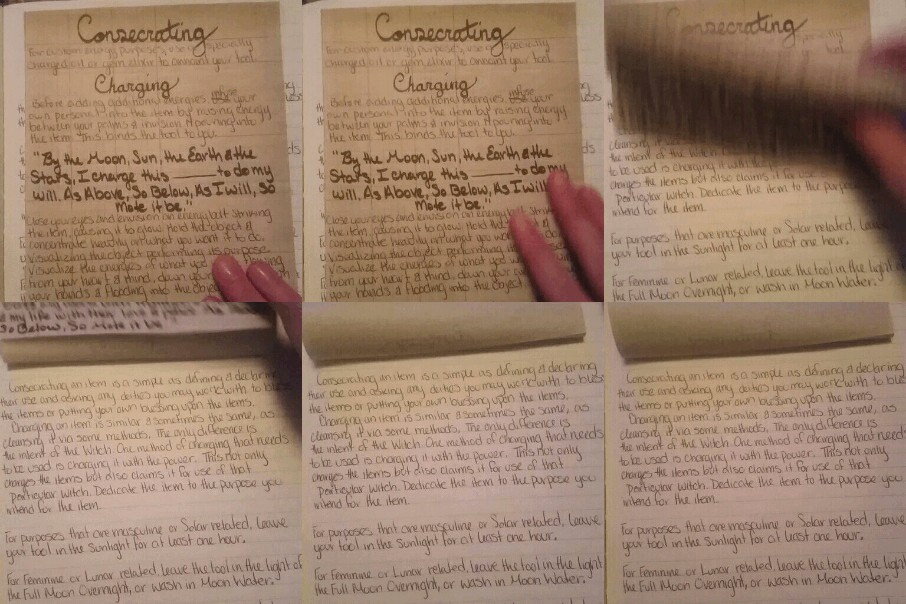
– Double pages. I always had a problem with “wasting” pages in my grimoire. For example, my page on consecrating and charging. These two concepts are very similar to me, and I didn’t want two page stating the same thing. So, what I did was write out all my information on charging on a separate sheet of paper, then glued the top of that page into my grimoire. This way I could flip up the page on charging (as if it were on a clipboard) and have my page on consecrating underneath.
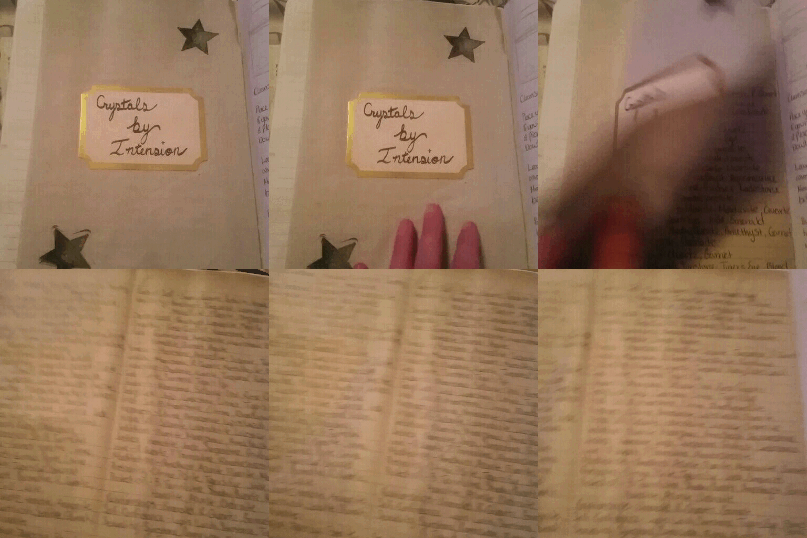
– Extended pages. Similar to the one above. In my Crystal section of my Grimoire, I decided to write out a chart that let me search for crystals by intention. So I drew my chart on a long sheet of paper, then folded it over (side to side) so that it fit comfortably in my book, then I just glued one side down into the book.
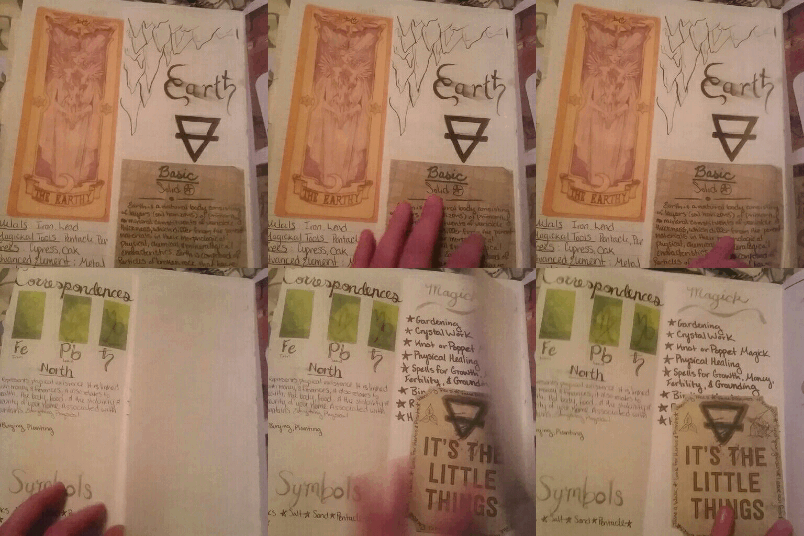
– Brochures. In my Elements section, I had a ton of information I wanted to write down, but I didn’t want each element to have more than two pages. So I used a piece of computer paper and folded it into a brochure (or into thirds) and glued it into the book so that the flaps would open and give me double the space to write.
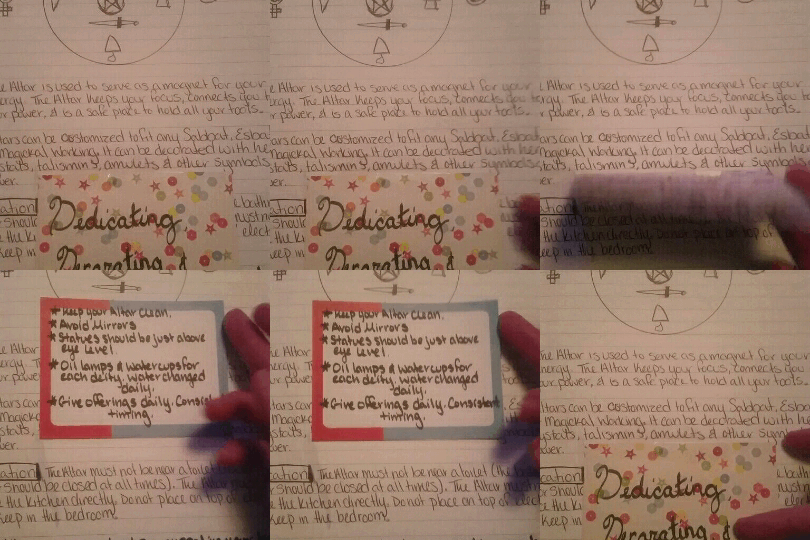
– Clear Tape. There are many times where i finished a page in my grimoire only to find out there was a section that I left out. A simply way to fix this was with clear tape. I would write my forgotten bit of into on a separate piece of paper and then use clear tape to tape one side of the paper to my page. This allows me to flip the paper back and forth without covering up anything that I had written.
I guess maybe @insaneastraldragon would wanna be mentioned here – my personal friend. I remember teaching him how to set up his shields, and then he went and made a fucking dragon. The student always surpasses the teacher, sigh…
I know of people who have written astral travel posts. You can always ask them these questions.
I do have a [tag for “astral”] on my blog that has a lot of posts. Maybe not some of the more specific ones regarding planes and denizens, but, you know. Stuff.
‘Walking the middle path’ is a term often used in DBT to describe finding the balance with black and white thinking. Above is an information sheet about various forms of black and white thinking, as well as a sheet of examples that seek to disprove black and white trains of thought.
From DBT Skills and Training, 2nd Edition, by Marsha M. Linehan.
Reblogging because I WISH I HAD FUCKING KNOWN ABOUT THIS IN HIGH SCHOOL YEARS AGO!
Dear sick Kitties,
Please save this to your computer because one day you might be well enough to work in some capacity and it’s unfair for you to have blank spots on your resume/CV.
You have worth and validity even if you don’t have a huge work history. YOU have value.
This is mostly really good, but I have a couple minor disagreements. So…here are three recommendations from an HR person who reads a shitton of resumes every day:
Move the skills section up to the top! You know what I give a fuck about the most when I’m reading a resume (at least for entry-level positions)? WHAT YOU CAN DO. I frankly don’t give a shit where you learned it. Tell me what you’re capable of in concrete terms, organized in a bullet-points list or table that I can quickly scan to see if you even stand a chance of matching what we need, because that is all I’m doing in those critical first couple of seconds that decides whether I even bother looking at the rest of the resume. (Which I get sounds kinda callous but when I have to get through a couple dozen resumes, meaning download, open, read, decide what to do, forward it to the appropriate person if it makes the cut with my comments/summary/recommendations, file it appropriately and go on to the next one, and get back to my other duties and responsibilities – which I don’t have enough hours in the day for as it is – I can’t afford to depth-read every single resume that hits my inbox.)
Include volunteer experience as work experience if you have any. Running the concession stand at a high school club event of some kind counts as cash handling and customer service experience. Making blog themes for your friends counts as web design experience. Just because you weren’t getting paid doesn’t mean it wasn’t work experience you can potentially leverage to get actual paying work.
Rework that top statement – in its current form it’s looking like some odd hybrid of an executive summary (good!) and an objective statement (bad!), and I’m not sure how I feel about it tbh. I think it’s the “leveraging…to positively contribute” bit that is pushing all my “ugh no fucking shit sherlock” buttons. Like…what were you going to say, that you want to skate along doing the bare minimum amount of work and you don’t give a shit about the organization’s goals? I see way too many regurgitated statements like that – “positively contribute” and “maximize success” and “utilize my skills to further goals” etc. – and they just make my eyes roll out of my head at this point because they’re so generically corporate. I’d rather see a declarative statement about what you are and what you can do, than what you want.
However, huge massive bonus points for putting language fluency right there at the top where I don’t have to go hunting for it – language skills are ALWAYS ALWAYS ALWAYS A PLUS and you want to highlight that shit as hard as you can. Shove that language fluency in my fucking face, PLEASE. Better that than having to scour your work history for mention of translation or anything like that, which I will only do if I’m A: already liking your qualifications so far, and B: totally fucking desperate for someone who speaks goddamn Spanish already.
When burning anything always keep a glass of water near you, unless you are working with burning oils, then keep a fire extinguisher or baking soda on hand.
When working with essential oils(EO), do not burn them they are highly flammable
Never leave anything burning unattended, be it a burn bowl, candle, incense. DON’T LEAVE IT!
Please remove anything flammable such as paper or string from the candle, it will ignite and you will be alarmed.
Make sure that what you’re burning your candle in is fire safe, metal and cast iron are good bets. Do NOT burn in a glass, if you have to put it out and dump water on it, it will explode.
Make sure you tie back loose hair and don’t have any floppy sleeves or necklaces to get in the way.
When putting out a candle it is best to use a candle snuffer and do not use water.
Don’t burn kitchen sage, it gives off a toxic smoke. Not something you wanna inhale.
Essential Oil Safety
Please, please dilute them properly. I have a chemical burn scar I can never get rid of due to undiluted cinnamon bark oil. The proper dilution is one drop per teaspoon.
Never ingest EO, there are some that are now generally recognized as safe by the FDA, but the quality of EO are not regulated. Who knows what a bad quality EO could do to your internal organs, not something I wanna test.
Essential Oils are photosensitive, meaning they deteriorate in light store them in a dark area to prevent them from spoiling.
DO NOT put them near on your skin and get in the sun or a tanning bed, especially citrus oils, they will blister.
Water will not dilute essential oils, only other oils(canola, olive, sweet almond, olive will all dilute). If you want to use them in a bath it is one drop per a teaspoon of oil.
Please seek medical attention if anything seems off after using EO, they seem harmless but can be very dangerous
Pets can be very sensitive to essential oils(particularly cats) and it is almost impossible to cover all my bases here. The sources provided below have some great resources.
Always go by the scientific name, German and Roman chamomile are very different products.
Kitchen Magic Safety
Wear shoes if you’re doing anything, I nearly lost a toe the other day cause I dropped a knife. I got lucky I was wearing boots.
Wear correct clothing, and tie back hair. No matter if you have a gas, electric or induction stove, I’ve caught a lab coat sleeve on fire thanks to a torch while making a creme brulee.
Use your knives correctly, learn about the pinch grip and use the correct knife for the job. Using a paring knife for chopping potatoes is asking for trouble. There are tons of videos online, I like the ones from Alton Brown and Jamie Oliver.
As a side note use sharp knives, a blunt knife will do more damage than a sharp one.
Don’t leave knives in the sink, someone could begin to wash dishes and cut themselves.
Watch the steam. Steam can give a worse burn than dry heat, open pot lids away from you and don’t stick your face and phalanges in steam.
Don’t leave food products unattended.
Use your damn pot holders, they protect you and your counters.
Store raw meat on the lowest shelves, and never store cooked meat on the same shelf
Wash your hands before, wash your hands after handling raw meats, wash your hands after.
Don’t leave food that is meant to be cold or hot out for more than 2 hours, this is to decrease foodborne illness.
When using the store turn handles in, to keep yourself from bumping them off the stove.
Cook meats to proper temps(there is a chart in the sources)
If you are using herbs be sure to use kitchen grade herbs, those that are not kitchen grade are not held up to the same purity standards and could have more pesticide residue.
Herbal Safety
Please be aware a lot of herbs can work against prescription medications, or should only be taken in very specific doses( St. John’s Wort I’m looking at you.) Check in with your doctor or a licensed herbalist or naturopath before ingesting herbs.
Crystal Safety
Identify your crystals, some are water solvent some are not and it matters
Some that aren’t safe in water include malachite and selenite. They have copper and if aren’t sealed they can become toxic. There is no way to know for sure if it was sealed or not keep -ite crystals dry as a good rule of thumb.
Some crystals fade in sunlight like rose quartz, amethyst and citrine, in order to prevent fading try cleansing them with sound, flower petals, moonlight and energy.
Why do my interests in canning, couponing, and homesteading overlap so often with blogs with titles like ‘The Obedient Housewife’?
Like, I’m like, “I want to learn to make soap and farm,” and suddenly I see 500 “traditional family” motherfuckers like no you are mistaken. I am just a simple lesbian anticapitalist looking to limit my consumerism as much as possible.
‘these fun crafts will keep your kids occupied until your husband gets home!’ no i want a clothespin crown for me
As a nerd who homesteads, let me share the data I have gathered!
First is my megalist of homesteading-related links I’ve gathered over the years. I’m a mod over at r/homesteading and this is where I’ve put a lot of good sources (not all, admittedly some are still sitting in my bookmark folder waiting to be added). The search function at reddit is wretched, but there’s also been lots of good things I’ve shared there too. Please note that many of these sources are not actual webpages, but PDFs. That’s not an accident, PDFs are where you find the really good in-depth stuff.
Many of my sources are from the Extension Service. They won’t try to relate to you based on your lifestyle or sexual identity or religion or whatever, but due to that, they also won’t be alienating you either.
The Cooperative Extension Service (US only) exists in all 50 states and in most counties. It is taxpayer funded. The Extension Service exists to help people become more self sufficient, for farmers to be more successful, for people to be healthier, for kids to be well adjusted, to figure out how to grow the best plants in your area, etc. Some county offices even offer cheap classes in things like gardening, canning, soap making, and they’re taught by people with training in these areas (I once heard a great talk on composting from a soil scientist that way). Do you want to know what type of plant something is? Do you need help figuring out a plant disease or pest issue? You can now contact them online and get great info.
I HIGHLY recommend checking out your state’s extension service website, because they do offer different types of information, depending on what is grown/raised where you are (and how well funded they are). My county extension puts out a monthly gardening newsletter, which includes a helpful ‘this is the time of the year to do —-’ part.
Here’s an example from New York – they have a calendar at the bottom, showing how they have things like hydroponic and urban agriculture workshops coming up.
Interested in raising animals? Penn State Extension is really really good. They have tons of free materials and courses available online, some I pulled for my megalist at the top of this.
National Center for Home Food Preservation – they cover the important aspects of food safety, and also have some recipes. Many state Extension Service websites will have lots more recipes.
If you have kids, check out4-H programs for them. It’s part of the local public school system here. If you’re homeschooling, you can also purchase their science-filled educational and self sufficiency materials (materials are divided by age ranges – Cloverbud Member: ages 5-8, Junior Member: ages 9-13, Senior Member: ages 14-19). One of my coworkers is in 4-H, she’s still in high school, and last year she raised an award-winning heifer.
Congress grants the money for funding these programs, and they’re connected with various universities. There’s a level of cutting edge scientific knowledge and academic rigor you don’t find in blogs or even most books. There’s LOTS of homesteading books filled with outdated information like ‘till the earth every year’ hell I still have older coworkers who do it and I’m trying to figure out how to gently tell them that they’re destroying their soil that way, and that there’s better methods now, methods grounded in science.


 sapphic-schizo