It’s not a stupid question at all, Anon, and I appreciate you asking. I’ll try to list them out in order of what I see most often in conversation, but I’m sure I’ll miss a few big ones that other people might be able to fill in over time.
Schizophrenics are violent. This is is absolutely not true and there are decades of statistics to prove it. This is probably the most damaging and most pervasive myth about schizophrenia circulating in western culture and is responsible for the most harm to those diagnosed with the disorder. We are not anymore prone to violence than your average person, but that doesn’t stop the media from using schizophrenia as a massive eye-draw any time one of us does happen to commit a violent crime. An important caveat here is that schizophrenics do have one of the highest rates of suicide in the United States, so although we are not more prone to hurting other people, we are observably more prone to hurting ourselves.
Schizophrenics can snap without warning. Totally untrue. We are not the living breathing embodiment of Jekyll and Hyde. If a schizophrenic is experiencing the beginnings of a psychotic break, there will absolutely be subtle but increasing signs leading up to actual onset starting several weeks or months in advance. Think of it less like a switch being flipped and more like the gradual erosion of a riverbank over time. The changes might take so long and be so subtle that the people around a schizophrenic might not realize how bad things have gotten (it’s called ‘insidious onset’, and in particular is how I developed the disorder), but it will be obvious that something isn’t right for weeks or months before full blown psychosis sets in.
You can ‘tell’ someone is schizophrenic. This might be true in some extreme cases, like someone who is unmedicated and in the throes of uncontrolled psychosis, but in general no, you can’t ‘see’ whether or not someone is schizophrenic anymore than you can ‘see’ that they have any other mental illness or physical disorder. Many of us don’t look sick. Many of us look and act completely normal on a day-to-day basis. It’s estimated that 3.2 million Americans are schizophrenic, and only a small percentage of them can be identified for the looking.
Schizophrenics have multiple/split personalities. No. False. Disassociative Identity Disorder (DID) is an entirely different and very, very rare disorder (less than 1% of the population, if that) and it has absolutely fuck-but-nothing to do with schizophrenia/schizoaffective/schizoform disorders. We do not have ‘split personalities’, and although some schizophrenics do talk to themselves while symptomatic or during psychosis, this is not indicative of other personalities somehow existing within that person.
Schizophrenics do what the voices tell them. Not all schizophrenics ‘hear voices’, but in most Western cultures the ones that do almost universally hate their ‘voices’ and wish they would go away. I’ve read academic studies out of Japan suggesting that the schizophrenic perception of ‘voices’ and their positive or negative tone is largely dependent on culture, however in general we don’t have a good relationship with our ‘voices’ and wouldn’t do the random, often very unpleasant things ‘they’ say unless severely psychotic.
Schizophrenics are homeless/can’t hold down a job. Eh. This is a huge misconception and misunderstanding of the disorder in general, but for you to really see the whole picture it’s important to know that in the US, about 20% of the homeless population is schizophrenic. Yes, you read that percentage correctly, and yes, it’s incredibly fucked up. I’m not a sociologist, but from my layman’s point of view the primary causes are lack of affordable psychiatric care, stigma against reporting onset of psychotic symptoms, and fear from potentially-helpful bystanders due to misconceptions about schizophrenia in general. Levels of functionality, ability, and self-awareness vary from case to case, and there is no single yardstick of capacity that can be held to all of us equally, but all of us, absolutely ALL OF US need support and understanding.
Schizophrenics are creatives/savants/visionaries. I wish this were actually true, but the reality is that mental illness is no more a path to creativity than having a broken arm or a stuffy nose. Some creatives happen to also be schizophrenic, yes, but by their very nature our symptoms work as much against creativity as they work on its behalf. Using myself as an example, in my twenties I was a published, decently prolific author before showing any real signs of schizophrenia/going through prodrome (a fancy word for initial onset of symptoms), but since developing the disorder despite still having creativity, my symptoms make it very difficult to write in the same way, with the same focus, or at the same length that I used to. In fact I can barely write within my genres at all. In short, there is no demonstrable, verifiable connection between schizophrenia and creativity, as much as I wish there were.
There are so many more, but this is getting really long and preachy already so I’ll end it. Other people will have more to add, I’m sure, and I know I’m forgetting or overlooking some important ones, but I hope this helps. If you are the Anon who’s asked questions of me before, I want to say again that you are welcome to ask whatever you want to or need to, no question is ‘stupid’, and I will be happy to answer what I can, when I can.
Your 13-year-old daughter tells a teacher that’s she’s uncomfortable
with her body. She prefers trousers to skirts, football to ballet. She
says she thinks she’s a he and wants to be treated as a boy at school.
Would the teacher tell you your daughter wants to change gender?
Your 11-year-old granddaughter comes home from school upset. Changing
after gym, another girl stood watching her undress and playing with her
penis. (The girl in question is transgender, so yes, she has a penis.)
When your family complains to the school, what happens?
In the first case, no, the teacher wouldn’t tell you. ‘All people,
including children and young people, have a right to privacy… Staff
should not disclose information that may reveal a pupil’s trans status
to others, including parents.’ In the second, it’s not the girl with a
penis who has a problem, it’s the girl without one. She and her parents
have wrongly assumed the child with the penis is ‘not a real girl’. That
error should be ‘challenged through training and awareness raising’ so
your granddaughter is comfortable with her classmate.
These cases are real. So are the responses, which come from the
Allsorts Trans Inclusion Schools Toolkit, guidelines for school staff
developed with Brighton and Hove City Council and used, in different
forms, by several dozen councils in England and Wales. It is
unsurprising that schools want guidance on how to deal with children
describing themselves as transgender, since more and more seem to be
doing so.
Why? Is it about tolerance: as society becomes more understanding,
more trans people feel able to ‘come out’? Could the internet be
accelerating ‘social contagion’, where the idea of being transgender
spreads rapidly?
What explains the disproportionate number of girls (child ‘assigned
female at birth’, to use the approved term) who are starting a journey
that can lead to hormone treatment, then binding and ultimately removing
their breasts? Is it possible that this is simply part of a wider
crisis of mental health among girls?
I don’t know, and neither do the doctors and scientists who study
this issue. If you talk to the clinicians at the Tavistock Clinic in
London, the NHS centre for the treatment of gender-variant children,
they’ll tell you that all the factors I mentioned may be at work, but
the evidence base is still incomplete, that they need more time and data
before offering explanations. (They’ll also tell you that quite a lot
of the children referred to them as ‘transgender’ will in time ‘desist’
and decide to live in their original gender.)
The government now intends to commission research into all this. You
might think that sounds sensible and mundane. You would be wrong.
According to Tara Hewitt, founder of the Trans Equality Legal
Initiative (TELI), prominent campaigner for transgender rights and an
adviser to numerous public bodies including the NHS, the proposed
research is ‘absurd and offensive’. The project should be ‘dropped in
the bin — it’s simply not an inquiry that needs to happen,’ Hewitt
reckons.
This is the quintessential trans-rights response to scrutiny: even
looking for facts about children’s welfare is transphobic. Just accept
that trans girls are girls and trans women are women. End of debate.
If you haven’t heard that mantra ‘trans women are women’, you will
soon, for it is the orthodoxy of the moment, a phrase even politicians
are expected to repeat as proof of their embrace of trans-equality. And
woe betide anyone who suggests that donning a dress and a new name
doesn’t magically render a male body female. Biology is transphobic too.
Women’s Minister Penny Mordaunt said the magic words in the summer
when she announced an overhaul of the Gender Recognition Act, the law
that allows someone to change their legal gender. Right now, a man can
legally be recognised as a woman if he ‘lives in gender’ for two years
and has that transition certified by a doctor.
Under reforms advocated by many (but not all) transgender
campaigners, such ‘gatekeeping’ would be scrapped and replaced by a
system of ‘self-identification’, that means that if a man says ‘I am a
woman’, he is in fact a woman and must be treated as such, with all the
legal and cultural rights that go with womanhood. Even before any change
in the law, public bodies and companies are effectively adopting such a
policy, often after receiving highly dubious quasi-legal advice from
lobby-ing groups.
Many people still have an idea that changing gender involves some
sort of physical change. In fact, sexual reassignment surgery is rare.
Many and probably most transgender people keep the bodies they were born
with; there are no official figures (the absence of good data defines
this issue) but some estimates suggest up to 80 per cent of ‘trans
women’ retain their male anatomy and genitals.
Exactly who counts as a trans woman is another issue where most of
the public might find some surprises. According to Stonewall’s ‘trans
umbrella’, you are transgender if you sometimes cross-dress.
That’s what makes Philip Bunce a woman, when he feels like it. Mr
Bunce is a senior Credit Suisse executive who sometimes wears a dress
and calls himself Pippa. On that basis, the FT recently named him one of its Top 100 Champions of Women in Business.
Such cases help explain why a significant number of women (and men)
are deeply uncomfortable with the agenda promoted by Stonewall, TELI,
Allsorts Youth Project and the rest of a loose network of ‘trans-rights’
advocates who enjoy immense influence in public life today, and
significant public funding.
Others groups include Mermaids and the Gender Identity Research &
Education Society, both frequently consulted by councils, NHS trusts,
police forces and Whitehall departments for guidance on applying the law
around transgender children. Both are tiny charities run not by lawyers
but by parents whose children changed gender; it’s hard to think of
another field of policy where personal experience is prioritised over
objective expertise.
According to Michael Biggs, an Oxford University sociologist, the
speed at which transgender rights advocates have advanced their cause is
unprecedented in western history. In less than a decade, he suggests,
the movement has embedded itself in public and corporate life and often
succeeded in changing policy and practice without significant scrutiny
or question.
How? Stonewall is the biggest exponent of the argument that trans
rights are the new gay rights, and that conflation of gay and trans is
key to the trans lobbyists’ power, especially in the public and
voluntary sectors, where allegations of intolerance can end careers. The
CEO of a major charity, a woman who has worked at board level in FTSE
100 companies, recently told me she was simply ‘too scared to speak
publicly’ about her fear that the systematic misapplication of equality
laws is eroding women’s rights and safeguarding rules. Being called a
bigot might cost her her job, she says.
In fact, a good many gay people are uncomfortable with the addition
of T (Transexual) to LGB (Lesbian, Gay, and Bisexual). Some of the most
vocal critics of transgenderism are lesbians, their concerns based in
part on the fact that one logical outcome of ‘trans women are women’ is
that lesbians should regard male-bodied trans women as female and thus
as potential sexual partners. Yes, this most progressive of social
movements tells women who really don’t like penises that they must
consider having sex with people who have penises.
Among the gay men voicing doubts about all this is Simon Fanshawe,
one of the founders of Stonewall, who now laments that there is ‘no room
for dissent’ from the official trans orthodoxy — even though many trans
people themselves are uncomfortable about the militancy practised in
their name. They fear that the policies promoted by the ‘trans women are
women’ camp risk a backlash against trans people as the wider
population notices the increasingly awkward consequences of the
doctrine. That day is fast approaching,
In the past month, the casual consumer of news media might have seen
any or all of the following stories in the headlines: a transgender
rapist was sent to a women’s prison where she used ‘her penis’ to
sexually assault women; Girl Guide leaders were expelled for questioning
a policy of allowing transgender girls (with penises) to share tents
and showers with girls born female; a Durham university student sacked
as editor of a philosophy journal for tweeting an article (by me) which
asked if it is a crime to say women don’t have penises; the removal on
grounds of transphobia of a billboard which repeated the dictionary
definition of ‘woman’ as ‘adult human female’.
All raise serious issues of public policy, yet politicians are
silent, fearful of questioning the trans-rights advocates and the
consequences of their orthodoxy. Sometimes with good reason, too. Those
MPs, mostly women, who have tried to debate this issue have been
showered with online hatred. I’ve stopped counting the politicians,
cabinet ministers among them, who tell me privately they worry about the
trans agenda but won’t say so publicly
That silence troubles me. I am no social conservative, no culture
warrior defending ‘traditional’ values. My interest here is fear of
political failure, of what happens when sensible politicians fail to do
their job by weighing evidence and reconciling conflicting interests.
The failure leaves the trans debate dominated by shrill and aggressive
groups intent on eliminating inconvenient evidence and dissenting views.
Failing to debate trans issues on the facts also creates the
conditions for deliberate and harmful populism. Rows about trans people
in bathrooms are a staple of America’s culture wars. The current vacuum
of leadership on the issue means Britain could easily go the same way,
if a politician on the make decided to make trouble. That would benefit
no one, least of all transgender people, who deserve to live their lives
with the same ordinary dignity as anyone else.
That’s not all that’s at stake. Trans-genderism is the perfect
ideology for the on-demand internet age. It gives unquestioned primacy
to ‘lived experience’, elevates emotion above evidence and convicts —
after instant trial by social media — any scrutiny or doubt of that most
heinous contemporary crime, intolerance. It chills debate and stifles
critical thinking.
Should policies and laws be made on the basis of facts and evidence,
or feelings and demands? You might not think so today, but the way our
political system responds to the transgender rights movement will matter
to everyone.
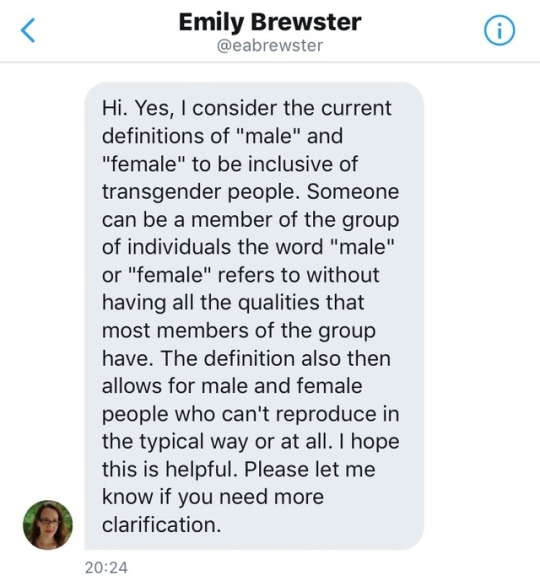
Emily Brewster is a lexicographer for Merriam-Webster, she recently reviewed all of merriam-Webster’s sex and gender definitions
These guys sure love to erase women don’t they.
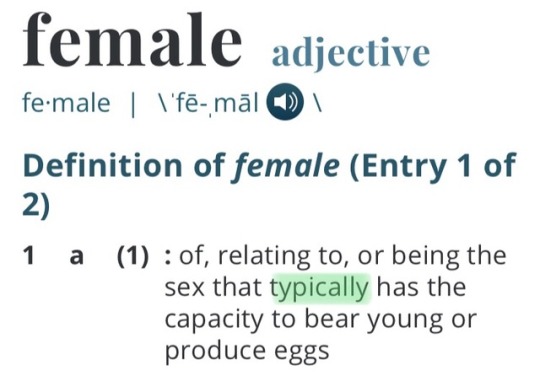
Nope, it does not. The definition clearly stated that TYPICALLY, wich means that it includes women who cannot bear young or produce eggs (infertile women).
I really fucking doubt the authenticity of the screenshot
It’s authentic and very obviously refers to infertile women, not trans.
Let me just direct you to a little part of the image above:
yeah, transmen lolol
Luckily I have proof other wise, you ain’t the first person to try that
Someone: do you feel the definition of Male includes trans men?
A lexicographer: yes
TERFs: hmmm I don’t knooow maybe she meant something else?
can…. can you read?? She said transgender people. Not transgender men. She dodged the question.
Who the fuck cares what fucking Emily Brewster says? That’s literally only her opinion. You could ask another lexicographer and get a completely different answer. But they probably all want to keep their jobs and break out in a cold sweat whenever someone asks about trans people lmao



 sapphic-schizo